
How Prop Traders Build Consistency Over Time


Consistency is the backbone of success in proprietary trading. Unlike retail traders chasing big wins, prop traders must deliver steady, reliable results to gain trust and access larger capital. This article dives into how prop traders achieve this, covering:
- Why consistency matters: It ensures income stability, builds credibility with firms, and supports effective risk management.
- Common pitfalls: Emotional trading, over-leveraging, lack of strategy discipline, and failure to adjust systematically to market changes.
- Core principles: The "consistency rule" focuses on steady, controlled performance over risky, one-off gains.
- Proven methods: Risk management (e.g., limiting risk to 1-2% per trade), following a trading plan, tracking and analyzing trades, and regularly refining strategies.
Platforms like TradersYard help traders by enforcing clear rules, offering simulated capital for practice, and rewarding disciplined trading with profit-sharing and scaling opportunities. Success comes down to combining structured habits, emotional discipline, and continuous improvement.
How I Achieve Consistent Prop Firm Payouts
The Consistency Rule: Core Principle of Prop Trading
The consistency rule is what separates disciplined traders from those who act on impulse. Instead of zeroing in on how much profit a trader can make, this rule focuses on the process and discipline behind their trades. The idea is straightforward: firms want traders who can deliver steady, repeatable profits without relying on risky, one-off wins that could jeopardize the firm's capital. By setting clear boundaries and trade requirements, the consistency rule helps traders avoid common pitfalls like emotional decision-making and over-leveraging. It’s not just a rule - it’s a framework that shapes daily trading decisions and serves as a foundation for long-term success.
Quick Calculator
Use the interactive calculator below to run your own numbers instantly.
Consistency Rule Calculator
This principle is a cornerstone of proprietary trading, guiding how firms evaluate traders and monitor their ongoing performance. Traders who stick to consistent practices during evaluations are far more likely to protect and grow the firm’s capital over time.
Understanding the Consistency Rule
The consistency rule hinges on several key components designed to enforce discipline. One of the most important is daily profit and loss caps, which prevent traders from experiencing extreme gains or losses in a single session. This encourages a steady distribution of performance rather than dramatic swings. Trade size limits work in tandem with these caps, ensuring that traders maintain appropriate position sizes relative to their account balance and avoid over-leveraging.
Many firms also impose limits on how much profit a trader can make in a single session - typically capping it at 40% of the total evaluation profit. This forces traders to demonstrate consistent success rather than relying on rare market anomalies. Minimum trade requirements, such as placing at least five trades per day over 15 business days, further encourage disciplined, regular activity instead of sporadic bursts of trading activity[4].
Another critical safeguard is the maximum drawdown limit, which protects both traders and firms from excessive losses. For instance, platforms like TradersYard enforce a 5% daily loss limit and a 10% maximum drawdown on all CFD accounts[1]. For a trader managing a $100,000 account, this means they can’t lose more than $5,000 in a single day or let their account equity drop by more than $10,000 from its starting balance.
Pros and Cons of the Consistency Rule
The consistency rule comes with both benefits and challenges, shaping how traders operate and how firms manage risk.
For traders, the rule offers a pathway to better emotional control and fosters sustainable trading habits. By capping daily profits and losses, it helps traders avoid the boom-and-bust cycles that often plague retail traders. It also builds trust with trading firms, opening doors to larger capital allocations and more favorable profit-sharing arrangements. Dominic Mang, a trader with TradersYard, highlighted this benefit when he said:
"Their clear rules and no hidden fees made it easy to focus on growing my account"[1].
For firms, the rule simplifies risk management and allows for more efficient capital allocation. When traders stick to defined parameters, firms can better predict losses and manage overall exposure. Research shows that institutions with strong consistency metrics enjoy better long-term returns and reduce the risk of catastrophic losses[3].
That said, the rule isn’t without its drawbacks. It can limit traders' ability to chase aggressive profits during periods of high market volatility, where opportunities for significant gains might arise. Additionally, strict adherence to the rule may encourage overly cautious trading, causing traders to miss out on favorable market movements.
Pros of the Consistency RuleCons of the Consistency RuleEncourages emotional control and disciplineLimits profit potential during volatile marketsPromotes sustainable trading habitsCan discourage calculated risk-takingBuilds trust and credibility with firmsMay lead to overly conservative tradingSimplifies risk management for firmsCould mean missed opportunities in unique market conditionsProtects against catastrophic lossesRestricts flexibility in adapting to market changes
Despite these challenges, many successful prop traders see the consistency rule as a valuable training tool rather than a hindrance. The discipline it demands often leads to stronger overall performance. Traders who master this balance - staying consistent while capitalizing on key opportunities - are the ones who thrive in proprietary trading environments.
Proven Methods for Building Trading Consistency
Achieving consistent results in trading isn't about luck - it's about committing to structured, reliable methods. Research shows that traders who stick to disciplined practices tend to perform better, even during periods of loss[3]. The secret lies in developing repeatable processes that can adapt to any market condition.
Risk Management Practices
Risk management is the backbone of consistent trading. A key element is position sizing, where most successful traders limit their risk to 1-2% of their account balance per trade. This approach helps control emotional reactions to losses and keeps the focus on long-term strategy[2][6].
Another critical tool is the stop-loss order, which acts as an automatic safeguard. Instead of holding onto losing trades in the hope they’ll recover, disciplined traders set their stop-loss levels before entering a position. This practice pairs well with maintaining strict risk-reward ratios - a common standard is a minimum 1:2 ratio, aiming to earn at least $2 for every $1 risked[2][6].
Platforms like TradersYard enforce disciplined trading by setting strict loss and drawdown limits. For example, they cap leverage at 1:30 for accounts ranging from $5,000 to $100,000, helping traders avoid over-leveraging - a mistake that can quickly derail consistency and lead to significant losses[1]. These safeguards encourage traders to adopt daily habits that promote steady performance.
With a solid risk management framework in place, traders can build and stick to detailed trading plans that further enhance consistency.
Creating and Following Trading Plans
A trading plan is your roadmap to disciplined decision-making. A well-thought-out plan reduces impulsive actions that can disrupt consistency[2][6]. The best plans include clear entry and exit rules, criteria for trade selection, and guidelines for trade size. For instance, a trader might decide to only trade during specific market hours, use technical indicators for entry signals, and exit trades at predetermined profit levels or stop-loss points.
Effective plans also outline how to manage trades, such as when to take partial profits or adjust stop-loss levels. Having these decisions pre-set helps traders stay calm and avoid emotional reactions during live market conditions.
For those trading with prop firms like TradersYard, aligning the plan with firm requirements is crucial. TradersYard, for example, requires participants to meet profit targets of 10% in the first phase and 5% in the verification phase, all while adhering to strict risk parameters. Balancing these profit goals with conservative risk management is key to success[1].
At the same time, a degree of flexibility is important. TradersYard allows news trading and holding positions over weekends, giving traders room to adapt their strategies while staying within defined risk limits[1]. This balance between structure and adaptability ensures traders don’t miss legitimate opportunities.
Trade Tracking and Analysis
Tracking and analyzing trades is essential for improving and maintaining consistency. By reviewing performance regularly, traders can spot patterns and make data-driven adjustments to their strategies[6][7]. Many successful traders maintain detailed journals that go beyond profit and loss numbers. They record trade setups, their emotional state during execution, and the market conditions at the time.
Key metrics to monitor include:
- Win rate
- Average profit/loss per trade
- Maximum drawdown
- Risk-reward ratio
- Consistency of daily or weekly returns
For example, if a trader notices a sudden increase in drawdowns, it could signal a lapse in risk management, prompting a review of recent trades and adjustments to strategy.
Tools like analytics software and journaling platforms make it easier to spot trends and refine methods[5][8]. Regular performance reviews - whether weekly or monthly - help traders stay objective by identifying where they’ve strayed from their plan, what worked well, and how market conditions influenced results.
Strategy Testing and Improvement
Consistency in trading requires constant refinement. Successful traders are always testing and improving their strategies to keep up with changing markets. This starts with back-testing, where traders evaluate how a strategy would have performed in past market conditions. Back-testing highlights both strengths and weaknesses, but the goal isn’t to create a perfect strategy for past data - it’s to develop one that works across a variety of scenarios[4][5][8].
Next comes forward-testing, where traders test strategies on live market data using simulated capital. This step helps them adapt to current conditions without risking real money. Platforms like TradersYard support this process by offering practice accounts with simulated capital and transparent performance tracking tools. These features allow traders to refine their methods in a risk-controlled environment before scaling up to larger accounts[1].
Markets are always evolving, which means strategies need to adapt as well. During periods of high volatility or major market shifts, traders often adjust by reducing position sizes, tightening stop-loss levels, or avoiding overtrading. For instance, during significant news events, it’s wise to lower exposure or switch to lower-risk setups to maintain consistency.
sbb-itb-1dce033
How TradersYard Helps Build Trading Consistency
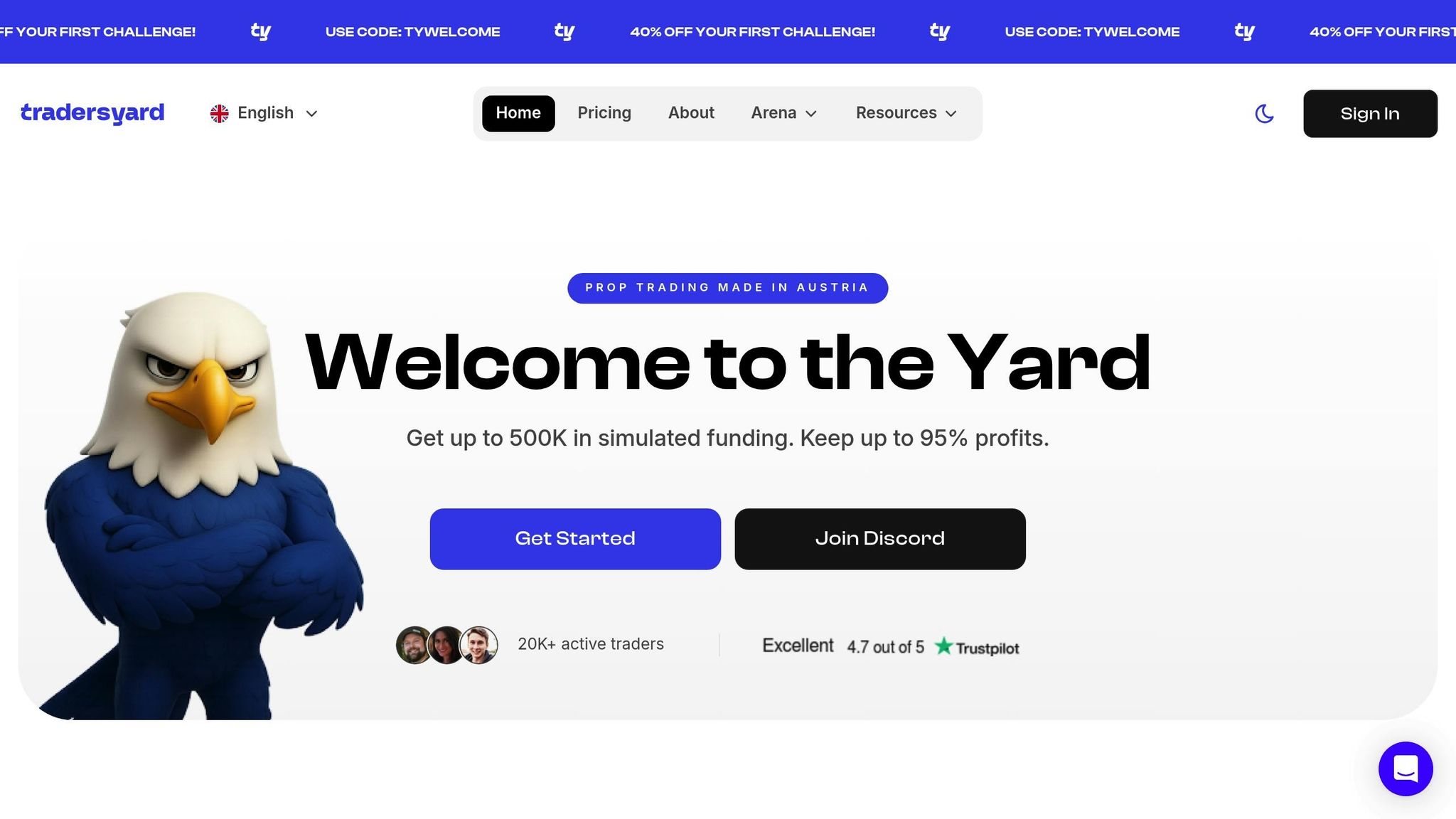
Achieving consistency in prop trading goes beyond mastering strategies - it requires the right tools, structure, and support. TradersYard provides a platform designed to nurture consistent performance through well-organized processes and trader-friendly features. At its core lies a structured evaluation system that reinforces the discipline necessary for steady trading success.
Structured Evaluation Process
TradersYard’s evaluation system is built to encourage disciplined trading habits through a two-phase process: Evaluation and Verification. In the Evaluation phase, traders aim for a 10% profit target, followed by a 5% target in the Verification phase to demonstrate consistent performance [1]. This clear structure helps filter impulsive decisions and fosters disciplined trading.
The platform enforces strict risk management rules across all account types, whether it’s the $5,000 beginner account or the $100,000 professional account. These guidelines help traders develop and internalize sound risk management practices [1].
One trader shared their experience with the platform's straightforward rules:
"I had a very good experience with tradersyard, recently I took part in their iphone trading competition, which was a two-week competition. With very simple easy-to-follow rules, I secured the 1st rank and was awarded with the iPhone 16 as first prize." - Ritik Kaushal, India [1]
By maintaining transparency in its rules, TradersYard removes unnecessary guesswork, allowing traders to focus entirely on executing their strategies within well-defined boundaries.
Features That Promote Consistency
TradersYard offers features specifically designed to address common trading challenges. For example, its no trailing drawdown policy eliminates the stress of constantly monitoring a moving loss threshold, enabling traders to focus on their strategies without added pressure.
The platform also rewards disciplined performance through a profit-sharing model that offers up to 95% payouts, alongside fast payment processing. One trader highlighted their positive experience:
"Very nice prop firm, they paid me today my first payout, so they are legit and the rules are simple. I like TradersYard." - Will Morningstar [1]
Additionally, TradersYard’s scaling program encourages ongoing consistency by providing larger capital allocations as traders grow their accounts. Features like news trading allowances and the ability to hold positions over the weekend offer flexibility for adapting strategies, all while adhering to strict risk controls.
Simulated Capital for Practice
To bridge the gap between theory and live trading, TradersYard offers up to $500,000 in simulated capital. This allows traders to practice large-scale trading without risking real funds.
The simulated environment provides a safe space for testing and refining strategies across different market conditions. Performance tracking tools help traders identify patterns and areas for improvement before transitioning to live accounts. This progression ensures that only consistently profitable traders advance, preparing them for the responsibilities of managing larger capital allocations.
Key Points for Building Consistent Prop Trading Performance
Achieving consistent performance in prop trading requires a blend of disciplined risk management, detailed analysis, and emotional control. These elements work together to protect capital, reduce impulsive decisions, and enhance long-term success, especially in volatile markets. Let’s break down the key factors that contribute to sustainable trading results.
Tracking and analyzing trades is essential for measurable growth. Keeping a detailed trading journal helps traders spot recurring patterns, evaluate how well they stick to their strategies, and identify which setups yield the best results in different market conditions [5][7]. This practice shifts trading from being a guessing game to a skill honed through systematic refinement.
Emotional discipline plays a crucial role in separating successful traders from those who struggle. Top traders develop habits to manage stress, step away after losses, and remain committed to their strategies, even during tough times [2][6]. This kind of discipline ensures that strategies are applied consistently, regardless of market fluctuations.
Platforms like TradersYard help reinforce these habits by creating a structured environment. Features such as no trailing drawdown and clear, transparent rules reduce unnecessary stress, enabling traders to focus solely on executing their strategies effectively [1].
Balancing aggression with consistency is another critical component. While aggressive trading can lead to impressive profits, it must be tempered with careful risk management and adherence to proven strategies [2]. Adjusting tactics based on market conditions and personal performance metrics ensures steady progress over time without exposing oneself to unnecessary risks.
Monitoring key metrics like win rate, average risk-to-reward ratio, maximum drawdown, and profit consistency across sessions is vital [4][3]. These benchmarks provide objective insights, helping traders pinpoint strengths and areas for improvement.
Approaching trading as a disciplined business practice is the foundation for long-term success. By following structured processes, analyzing every trade, and staying disciplined even in challenging markets, traders can achieve the sustainable performance that prop firms value and reward.
FAQs
How does building consistency help prop traders manage risk and improve their performance? +
Consistency plays a key role for prop traders, as it reduces emotional decision-making and encourages disciplined execution of trading strategies. By adhering to a clear plan and fine-tuning their methods over time, traders can better control risk and achieve more stable results.
Top-performing traders often dedicate time to tracking their performance, identifying patterns, and making informed, data-driven adjustments. This approach not only sharpens their skills but also boosts confidence - an essential trait for weathering the highs and lows of trading. Platforms like TradersYard support this journey by providing structured environments with clear rules, evaluation systems, and tools designed to help traders maintain consistency.
How can prop traders stay disciplined and avoid emotional trading? +
Discipline and steering clear of emotional trading are key to achieving long-term success as a prop trader. To stay on track, traders should fine-tune their strategies, follow well-defined trading plans, and stick to clear, straightforward rules.
Platforms such as TradersYard play a helpful role by providing structured evaluation systems, clear guidelines, and tools designed to promote consistency. By focusing on discipline and strategy rather than making impulsive choices, traders can develop sustainable habits that enhance their overall performance.
How does TradersYard help traders develop consistent trading habits? +
TradersYard helps traders develop strong, consistent habits by providing a clear evaluation process and straightforward trading rules. These tools are designed to help traders sharpen their strategies while staying disciplined over time.
The platform also offers simulated funding of up to $500,000, allowing traders to practice and enhance their skills in a controlled, low-risk setting. Features like no trailing drawdowns, quick payouts, and scaling programs are tailored to support traders in achieving steady progress and improving their overall performance.
Related Blog Posts
- Prop Trading Rules: Complete Checklist for Success
- What Is Prop Trading? Common Questions Answered
- How to Manage Drawdown in Prop Trading Accounts
- Checklist for Scaling Prop Trading Accounts